What I’ve read/listened to this year
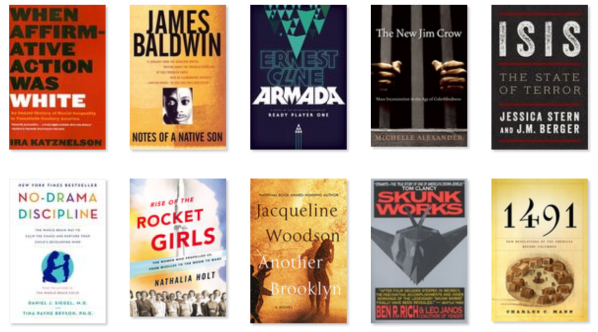
I had a goal of reading 52 books this year. I ended up with 53. Not bad. Some have asked how I could achieve this. I have an hour commute each day and listen to most books at 2x speed. You would be surprised how many books you can get through doing that.
f you’ve read something good this year, comment below.
Sleeping Giants (Themis Files, #1) – audio – Tried this on a whim and was pleasantly surprised. It has the feel of World War Z as the narrative is told in interviews, journal entries, transcripts, and news articles. The audio was really well done as each person is narrated by a different voice. A
Finding God in the Waves: How I Lost My Faith and Found It Again Through Science – audio – B
1491: New Revelations of the Americas Before Columbus – audio – This should be required reading for all Americans. This book turns on its head pretty much everything we have been taught and learned about those native to America and the societies they built before colonizers arrived. It is not a dry history book at all. It is well written and researched and presented in a way to keeps you engaged. A+
Skunk Works: A Personal Memoir of My Years at Lockheed – audio – Listened to this on a recommendation and really glad I did. So fascinating about this secretive division of Lockheed Martin and the development of some of the most iconic aircraft every built. A+
Another Brooklyn – audio – Quite enjoyed this. Beautifully written in poetic style. A
Rise of the Rocket Girls: The Women Who Propelled Us, from Missiles to the Moon to Mars – audio – Well written and engaging. I learned so much about the history of JPL and the elite group of women mathematicians who made the exploration of space possible. A+
No-Drama Discipline: The Whole-Brain Way to Calm the Chaos and Nurture Your Child’s Developing Mind – audio – “Defining the true meaning of the ‘d’ word (to instruct, not to shout or reprimand), the authors explain how to reach your child, redirect emotions, and turn a meltdown into an opportunity for growth.” The premise is that emotions are good (imagine that) and that children get overwhelmed by them and our job as parents is to help them understand and control them. A
ISIS: The State of Terror – audio – A
The New Jim Crow: Mass Incarceration in the Age of Colorblindness – audio – Well written and thoroughly researched, Alexander argues that the racial caste system has always existed in this country, it just continues to change forms from slavery to Jim Crow to segregation to mass incarceration. “Alexander shows that, by targeting black men and decimating communities of color, the U.S. criminal justice system functions as a contemporary system of racial control, even as it formally adheres to the principle of color blindness”. A
Armada – book – Definitely not on the same level as his other book, Ready Player One. B+
Notes of a Native Son – audio – A
When Affirmative Action Was White: An Untold History of Racial Inequality in Twentieth-Century America – audio – The information in this book was completely new to me. This book should be required reading for every white person in this country. This book exposes the harsh racial discrimination in the implementation of New Deal and Fair Deal era policies and how this has, over the last 70 years, led to the widening inequality gap between whites and blacks. A+
Searching for Sunday: Loving, Leaving, and Finding the Church – audio – B+
The Bible Tells Me So: Why Defending Scripture Has Made Us Unable to Read It – audio – I had seen a number of people talking about this book, so I gave it a listen. He tries to make the case that the stories in the Old Testament can be explained simply in terms of myth and lore. I just didn’t buy his thesis. Especially in light of books like From Eternity to Here and Jesus: A Theography, both by Frank Viola, which show how all the stories in the Old Testament are a shadow of Jesus. D
NeuroTribes: The Legacy of Autism and the Future of Neurodiversity – audio – A thoroughly researched and well written history of autism. Silberman shows how rates of autism can easily be explained by an ever expanding definition. He suggests a path for acceptance, understanding, and full participation in society for people who think differently and we would do well to listen. A+
The Circle – audio – B
The Zimzum of Love: A New Way of Understanding Marriage – audio – B+
The Bear and the Nightingale (Winternight Trilogy, #1) – audio – This is incredibly well written and beautifully told story, written in the style of a Russian fairy tale. Highly recommended. Excited to read the other two book in the series. A+
News of the World – audio – B+
The Daily Show: An Oral History as Told by Jon Stewart, the Correspondents, Staff and Guests – audio – A+
Freedom Is a Constant Struggle: Ferguson, Palestine, and the Foundations of a Movement – audio – A
Harry Potter and the Chamber of Secrets (Harry Potter, #2) – audio – A+
Dark Matter – audio – If I try to explain anything else about this book, I would end up ruining it. Just read it. Seriously, it is so good and you never see the twists coming. A+++
Jesus Feminist: An Invitation to Revisit the Bible’s View of Women – audio – For those who already hold a view that men and women are equal, including in every aspect of Christianity, there won’t be a whole lot new in this book, but it is a great intro to the subject for those wanting to explore this topic. A
What We Talk about When We Talk about God – audio – B+
Exit West – audio – A-
An Altar in the World: A Geography of Faith – audio – A book about discovering the sacred in the small things we do everyday. It was good, but I had trouble staying engaged. B
Love Wins: A Book About Heaven, Hell, and the Fate of Every Person Who Ever Lived – audio – A
Evicted: Poverty and Profit in the American City – audio – One of the best ethnographies I have read in a while, also, horribly depressing. A
Harry Potter and the Prisoner of Azkaban (Harry Potter, #3) – audio – A+
And Every Morning the Way Home Gets Longer and Longer – audio – B+
The Hidden Life of Trees: What They Feel, How They Communicate – Discoveries from a Secret World – audio – This books was so fascinating. I learned more about trees than I ever thought I wanted to know. How they live in community, how they talk to each other, how they smell, and how they react to outside stimuli. Engaging and never dry. Highly recommend. A++
Tribe: On Homecoming and Belonging – audio – A
Snow Crash – audio – A
The Road Back to You: An Enneagram Journey to Self-Discovery – audio – It’s hard to listen to and absorb everything. Better to read. B+
The Whole-Brain Child: 12 Revolutionary Strategies to Nurture Your Child’s Developing Mind, Survive Everyday Parenting Struggles, and Help Your Family Thrive – audio – A
I Contain Multitudes: The Microbes Within Us and a Grander View of Life – audio – B+
The Wright Brothers – audio – Up to this point, my knowledge of the Wright Brothers was limited to their first flight. This book details everything that got them to that point and the years following as they perfected their craft. Worth your time. A+
The Lost City of Z: A Tale of Deadly Obsession in the Amazon – audio – The descriptions of the bugs, creatures, and diseases that awaited anyone trekking through the Amazon was very thorough. I can still feel my skin crawling. A
Longitude: The True Story of a Lone Genius Who Solved the Greatest Scientific Problem of His Time – audio – Who knew there was so much to learn about this topic? Enjoyed it. A
Executing Grace: How the Death Penalty Killed Jesus and Why It’s Killing Us – audio – A+
The Idealist: Jeffrey Sachs and the Quest to End Poverty – audio – A
I Shall Not Hate: A Gaza Doctor’s Journey on the Road to Peace and Human Dignity – audio – A
Harry Potter and the Goblet of Fire (Harry Potter, #4) – audio – A+
Stardust – audio – Surprised with just how different this was from the movie. A
Waking Gods (Themis Files, #2) – audio – Enjoyed this as much as the first book the series. A
White Trash: The 400-Year Untold History of Class in America – audio – A good history of class issues in this country, if only she hadn’t separated race and class and discussed these issues as if only poor white people were affected. C
They Can’t Kill Us All: Ferguson, Baltimore, and a New Era in America’s Racial Justice Movement – audio – A
We Were Eight Years in Power: An American Tragedy – audio – A+
Tears We Cannot Stop: A Sermon to White America – audio – This was absolutely fantastic and a book that white Christians would do well to sit and wrestle with. A+
I am Legend – audio – So, so, so different from the movie. It was really good…but depressing. A+
Artemis – book – I had high expectations after The Martian and I really wanted to like this book, but it was highly disappointing. The plot/storyline just wasn’t as good and the ending left much to be desired, but more than anything, it was the quite overt sexism of a man writing a story narrated in the first person by a 26-yr woman. D
The Hobbit – audio – The narrator of this book is amazing and really brought the book to life. Also, how is it that I just read/listened to this book for the first time ever? I really enjoyed it, however, now it makes me dislike the movies. A+
Dale Hansen on race relations
He has a message everyone needs to hear:
A couple of quotes from the video:
“Kids have to be taught to hate…and it’s our parents and grandparents, and teachers, and coaches too who teach us to hate. Kids become the product of that environment.”
“They will change. Not all of them, it never is…but not if we try to defend what you cannot defend and not if we stay silent…”
Documentaries I’ve seen recently
Dirty Wars – The film “follows investigative reporter Jeremy Scahill into the heart of America’s covert wars, from Afghanistan to Yemen, Somalia and beyond…as Scahill digs deeper into the activities of JSOC, he is pulled into a world of covert operations unknown to the public and carried out across the globe by men who do not exist on paper and will never appear before Congress. In military jargon, JSOC teams “find, fix, and finish” their targets, who are selected through a secret process. No target is off limits for the ‘kill list,’ including U.S. citizens.”
It is hard to like a film of this nature. As the website says, viewers are “left with haunting questions about freedom and democracy, war and justice.” However, this is a film everyone needs to see, especially if you want to understand how these actions cause others around the world to view the US and its citizens.
Five Broken Cameras – The film is a deeply personal, first-hand account of life and non-violent resistance. It “really is about those cameras. The lifespan of each camera frames a chapter in the struggle of the Palestinian village of Bil’in…against expanding Israeli settlements and the path of the country’s approaching security fence, which together would consume much of the village’s cultivated land. The cameras also capture the growing awareness and puzzlement of a little boy born into a world torn by a conflict that adults can barely comprehend.” [PBS]
The film shows a different view of the conflict between Israel and Palestine, which means many people won’t watch it as it goes against all their preconceived ideas of what is really happening. Yet, to truly understand a situation, you have to hear both sides. Highly recommended.
Inequality for All – a film that follows former U.S. Labor Secretary Robert Reich as he examines the economic and social consequences being caused by the widening gulf between rich and poor in the United States.
It is hard to fathom that so many people still don’t believe that income inequality is real and a major issue with far reaching consequences. With that said, this film presents overwhelming evidence of the history of income equality, how it looks today, and the consequences if the gap continues to widen.
Happy – “…takes us on a journey from the swamps of Louisiana to the slums of Kolkata in search of what really makes people happy. Combining real life stories of people from around the world and powerful interviews with the leading scientists in happiness research, HAPPY explores the secrets behind our most valued emotion.” [IMDB]
I thought it was interesting and definitely makes you think about how much we quantify and research depression, but don’t do nearly as much for the opposite: happiness.
Miss Representation – The film “exposes how mainstream media contribute to the under-representation of women in positions of power and influence in America. The film challenges the media’s limited and often disparaging portrayals of women and girls, which make it difficult for women to achieve leadership positions and for the average woman to feel powerful herself.”
This documentary makes me scared to have a daughter. Having said that, I would welcome the chance to have a daughter and build into her, helping her understand her true identity. At the same time I am excited to raise my son to view and treat women with the dignity and respect every single human deserves. The same filmmakers have filmed a similar documentary focusing on boys called “The Mask You Live In.” I haven’t seen it yet, but I really want to.
If you’ve watched any of these, what are your thoughts? If you’ve seen another good documentary, post the title in the comments.
Einstein on Racism and America
This is from an essay Einstein penned in 1946:
Many a sincere person will answer: “Our attitude towards Negroes is the result of unfavorable experiences which we have had by living side by side with Negroes in this country. They are not our equals in intelligence, sense of responsibility, reliability.”
I am firmly convinced that whoever believes this suffers from a fatal misconception. Your ancestors dragged these black people from their homes by force; and in the white man’s quest for wealth and an easy life they have been ruthlessly suppressed and exploited, degraded into slavery. The modern prejudice against Negroes is the result of the desire to maintain this unworthy condition.
The ancient Greeks also had slaves. They were not Negroes but white men who had been taken captive in war. There could be no talk of racial differences. And yet Aristotle, one of the great Greek philosophers, declared slaves inferior beings who were justly subdued and deprived of their liberty. It is clear that he was enmeshed in a traditional prejudice from which, despite his extraordinary intellect, he could not free himself.
A large part of our attitude toward things is conditioned by opinions and emotions which we unconsciously absorb as children from our environment. In other words, it is tradition—besides inherited aptitudes and qualities—which makes us what we are. We but rarely reflect how relatively small as compared with the powerful influence of tradition is the influence of our conscious thought upon our conduct and convictions.
He goes on to state that “we must begin to control tradition and assume a critical attitude toward it, if human relations are ever to change for the better. We must try to recognize what in our accepted tradition is damaging to our fate and dignity—and shape our lives accordingly.” And this is the crux of the matter. Many people don’t question things, believing the status quo is good enough and believing that because they don’t see “racism” it doesn’t exist. But maybe the reason they don’t see it is because they have never stopped to question their perceptions, the lenses they view everything through, and the traditions they hold.
How to care for introverts
I wholeheartedly endorse this list of ways to care for introverts (found here):
1. Respect their need for privacy
2. Never embarrass them in public
3. Let them observe first in new situations
4. Give them time to think; don’t demand instant answers
5. Don’t interrupt them
6. Give them advance notice of expected changes in their lives
7. Give them 15 minute warnings to finish whatever they are doing
8. Reprimand them privately
9. Teach them new skills privately
10. Enable them to find one best friend who has similar interests & abilities
11. Don’t push them to make lots of friends
12. Respect their introversion; don’t try to remake them into extroverts
Items 2, 3, and 4 are the most relevant ones for me. Related to this topic, I have been reading the book “Quiet: The Power of Introverts in a World That Can’t Stop Talking” by Susan Cain. I haven’t gotten too far into it, but what I have read has been excellent and eye opening.
 Hands Wide Open